Mako · Partial knee · Leesburg, VA

Robotic partial knee replacementReplace only what's worn.

When arthritis is limited to one part of the knee, a Mako partial knee replacement resurfaces just that compartment and keeps your healthy bone and ligaments. Dr. Nauman Akhtar has performed robotic-arm assisted knee surgery in Loudoun County for more than a decade.

Medically reviewed by Nauman J. Akhtar, MD · Updated October 2026
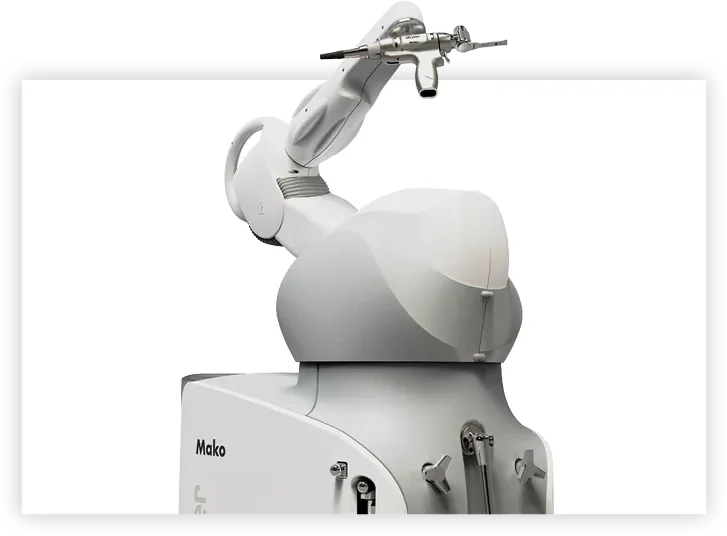
Mako robotic arm configured for knee surgery

Who it's for

Arthritis in one compartment

Your knee has three compartments: the inner (medial) side, the outer (lateral) side and the joint behind the kneecap. “Some people may have just one or two compartments affected by arthritis, but the rest of their knee is healthy,” says Dr. Akhtar.

According to the American Academy of Orthopaedic Surgeons, you may be a candidate for a partial knee replacement when your arthritis is limited to one compartment. It is usually not recommended with inflammatory arthritis, significant knee stiffness or ligament damage. Pain mostly on the inside or outside of the knee points toward a partial replacement; pain across the whole knee usually points toward a total replacement.

“Our first approach is always to do the more conservative thing,” Dr. Akhtar says. Surgery is considered when knee pain is present daily and keeps you from the things you enjoy.

Why robotic

Precision for a smaller operation

A partial knee implant is small, so where it sits matters. Before surgery, a CT scan of your knee becomes a 3D model, and Dr. Akhtar plans implant size and position on it. During surgery he guides the Mako robotic arm, which helps keep the work inside the area he planned.

“The advantages of MAKOplasty is it provides a minimally invasive way to more accurately and more precisely reconstruct a knee in patients who have only partial wear and disease in their knee,” he says.

Evidence

What the research shows

  • Accuracy. In a randomized trial of 139 patients, robotic partial knee replacement placed implants more accurately than conventional surgery in every measured direction. For the tibial component, 80% of robotic cases were within 2° of the planned position, compared with 22% of conventional cases. Bell SW, et al. J Bone Joint Surg Am. 2016;98(8):627–635.
  • Outcomes. In the TOPKAT randomized trial of 528 patients with arthritis on the inner side of the knee, partial knee replacement was as good as total knee replacement at five years and more cost-effective. More partial knee patients said they would have the operation again. TOPKAT trial, The Lancet, 2019.
  • Durability. In a four-center study of Mako partial knee replacement, 97% of knees were still in place at a mean of 5.7 years, and 91% of patients were satisfied or very satisfied. At ten years, 91.7% of implants remained in place and 91% of patients were still satisfied. Kleeblad LJ, et al. J Arthroplasty. 2018;33(6). Bayoumi T, et al. J Bone Joint Surg Am. 2023.

Recovery

What to expect

The AAOS lists quicker recovery, less pain after surgery and less blood loss among the advantages of partial over total knee replacement, and notes that many patients say the knee feels more natural. Patients usually spend little or no time in the hospital, put weight on the knee right away, and resume regular daily activities by about 6 weeks.

“With partial knee replacement, people get a much more natural feeling knee and that's part of the reason why they recover faster,” says Dr. Akhtar. Afterward he recommends activities like biking, elliptical training and swimming, and limiting high-impact exercise like running.

One trade-off: if arthritis later develops in another part of the knee, a total knee replacement may be needed in the future.

Questions

Common questions

Can a partial knee be changed to a total knee during surgery?

Yes. If Dr. Akhtar finds during the operation that a partial replacement isn't suitable, he can perform a total knee replacement instead. You'll talk about this possibility before surgery.

Does the robot perform the surgery?

No. Dr. Akhtar performs the surgery and guides the robotic arm. The arm helps keep the work within the plan he made from your CT scan.

How do I know which compartment is affected?

An exam and standing X-rays at your consultation show where the cartilage has worn. Sometimes additional imaging is needed.

More procedures

Request a consultation

Find out what precision could mean for your knee, hip or shoulder.

Bring any recent X-rays or MRI reports. You will leave with a clear answer on your options, including treatments that don't involve surgery.

Book with The Orthopedic Group
Dr. Akhtar's direct line(571) 209-1875
OfficeThe Orthopedic Group
19450 Deerfield Avenue, Suite 200
Leesburg, VA 20176
Practice groupProud member of Loudoun Medical Group
AffiliationsInova Loudoun Hospital
Loudoun Ambulatory Surgery Center
StoneSprings Surgery Center
Point of Rocks Surgery Center