Mako · Total knee · Leesburg, VA

Robotic total knee replacementPlanned around your anatomy.

For arthritis throughout the knee, Dr. Nauman Akhtar uses Mako robotic-arm assisted total knee replacement. Your implant size, position and alignment are planned in 3D from your own CT scan before surgery begins.

Medically reviewed by Nauman J. Akhtar, MD · Updated October 2026
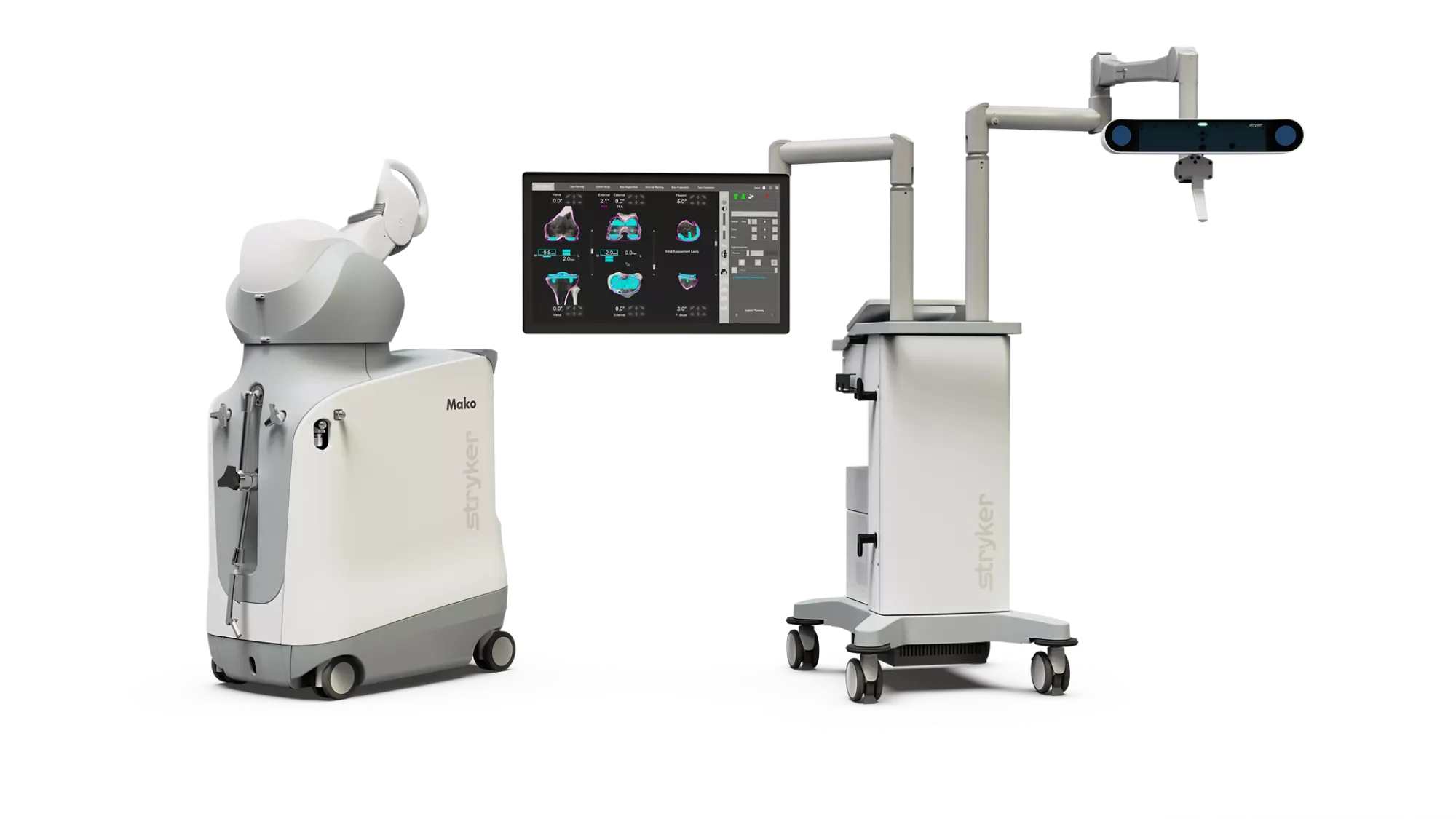
Stryker Mako robotic arm with navigation camera and planning display

Who it's for

Arthritis across the knee

A total knee replacement is usually the better choice when arthritis affects more than one compartment of the knee. “I tell patients to think about what their arthritis pain is doing to their life on a daily basis,” says Dr. Akhtar. “If people are unable to do the things that they love doing, those are the people who are candidates for surgery.”

Age alone doesn't decide it. In his words, the decision “has more to do with your symptoms, and less to do with your age.”

How it works

Scan, plan, perform

  1. Scan. A CT scan of your knee is turned into a three-dimensional model of your bones.
  2. Plan. Dr. Akhtar uses the model to choose implant size, position and alignment, and to plan how the joint will be balanced.
  3. Perform. In the operating room he guides the Mako robotic arm. Its tactile boundaries help keep bone preparation within the planned area, which is designed to protect surrounding bone and soft tissue. The joint is balanced during surgery.

Evidence

What the research shows

  • Faster early recovery. In a study of 80 consecutive patients, robotic-arm assisted total knee replacement was associated with less pain after surgery, less need for pain medication, better knee bend at discharge and a shorter hospital stay than conventional surgery: a median of 77 hours versus 105 hours. Kayani B, et al. Bone Joint J. 2018;100-B(7):930–937.
  • Fewer dissatisfied patients. In 1,434 knee replacements at one center, patients who had robotic-arm assisted surgery were less often dissatisfied two years later than patients whose surgery used computer navigation alone: 3% versus 9%. Tay ML, et al. Bone Joint J. 2025;107-B(8):804–812.
  • The honest picture. A 2025 review of ten systematic reviews found robotic total knee replacement consistently improves alignment accuracy, and some studies show shorter stays and less early pain. Long-term superiority in function and implant survival is not yet proven. García-Sanz F, et al. J Clin Med. 2025;14(8):2588.

Studies describe groups of patients treated by specific surgeons. Your own result depends on your condition, health and recovery.

Recovery

The weeks after surgery

Typical milestones described by the American Academy of Orthopaedic Surgeons:

  • Within hours: most patients begin exercising the knee and walk with a walker, crutches or cane soon after.
  • Same day or next: some patients go home the same day; others stay overnight.
  • First several weeks: plan for help at home with cooking, shopping, bathing and laundry.
  • 3 to 6 weeks: most normal daily activities return. Most people drive again at about 4 to 6 weeks.
  • Long term: walking, swimming, golf, biking, light hiking and dancing. High-impact activities like running and jumping are generally discouraged.

“Modern hip and knee replacements usually last 15 to 20 years, depending on how you use them,” says Dr. Akhtar.

Questions

Common questions

Why do I need a CT scan?

The CT scan builds the 3D model of your knee that Dr. Akhtar uses to plan your surgery and that the robotic arm uses during it.

Is robotic knee replacement covered by insurance?

Coverage depends on your plan. The office can help you check before surgery.

Can I go home the same day?

Some patients can. It depends on your health and support at home, and you'll decide it together with Dr. Akhtar.

More procedures

Request a consultation

Find out what precision could mean for your knee, hip or shoulder.

Bring any recent X-rays or MRI reports. You will leave with a clear answer on your options, including treatments that don't involve surgery.

Book with The Orthopedic Group
Dr. Akhtar's direct line(571) 209-1875
OfficeThe Orthopedic Group
19450 Deerfield Avenue, Suite 200
Leesburg, VA 20176
Practice groupProud member of Loudoun Medical Group
AffiliationsInova Loudoun Hospital
Loudoun Ambulatory Surgery Center
StoneSprings Surgery Center
Point of Rocks Surgery Center